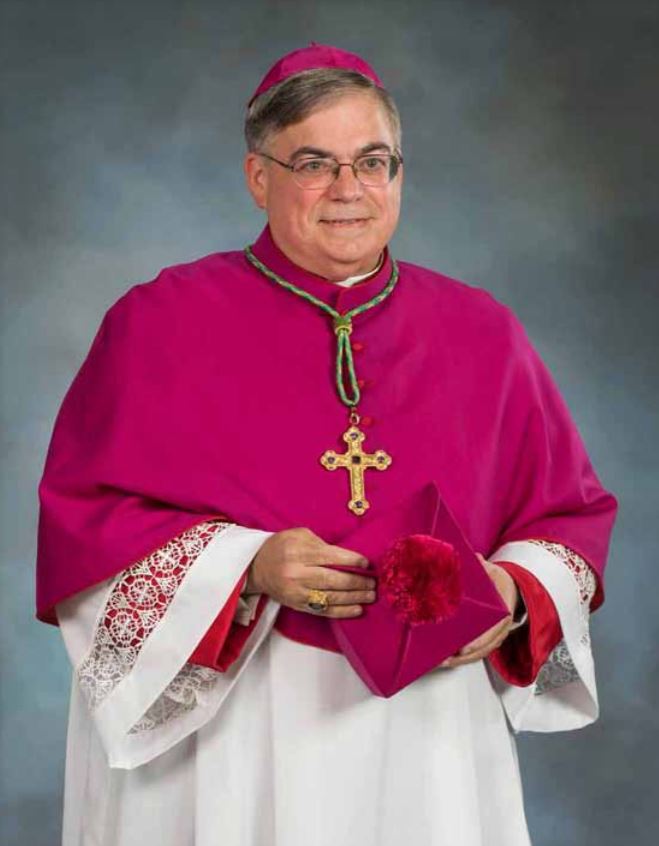
Bishop Alfred A. Schlert was born to Alfred and Marylou Schlert
in Easton on July 24, 1961, and was educated at St. Jane Frances de
Chantal Elementary School, Easton and Notre Dame High School,
Easton. He prepared for the Priesthood at St. Charles Borromeo
Seminary, Philadelphia, the Pontifical Roman Seminary, Rome and
St. John Lateran University, Rome. He was ordained a priest at the
Cathedral of Saint Catherine of Siena, Allentown on September 19,
1987 by The Most Reverend Thomas J. Welsh, Second Bishop of
Allentown.
He served as a Parochial Vicar at St. Francis of Assisi Church,
Allentown, as a Professor at his alma mater, Notre Dame High
School, Easton and as the Catholic Chaplain at Lehigh University,
Bethlehem. During his years at Notre Dame High School, he resided
at St. Anthony of Padua Church, Easton, St. Bernard Church, Easton
and Sacred Heart Church, Bath. He completed graduate studies
at the Pontifical North American College, Rome and the Pontifical
Lateran University, Rome where he received a Licentiate in Canon
Law in 1992.
He was named Vice Chancellor and Secretary to Bishop Welsh in
1997 before being named Vicar General of the Diocese by The Most
Reverend Edward P. Cullen, Third Bishop of Allentown, in 1998.
As Vicar General, he oversaw the coordination of all administrative
offices of the Diocese. From 1998 to 2008 he was in residence at the
Cathedral of Saint Catharine of Siena, Allentown. While still serving
as Vicar General, he was appointed Pastor of St. Theresa of the Child
Jesus Church, Hellertown in July 2008. Upon the Ordination and
Installation of The Most Reverend John O. Barres, Fourth Bishop of
Allentown, he was reappointed as the Vicar General of the Diocese
and resumed full-time service as Vicar General in February 2010,
with residence at St. Theresa of the Child Jesus, Hellertown (PA), until his
Ordination as the Fifth Bishop of Allentown.
Pope St. John Paul II named him Chaplain to His Holiness with the
title of Monsignor in 1999. Pope Benedict XVI named him a Prelate
of Honor, the second highest rank of Monsignor, in 2005.
Bishop Schlert served as Vice President of the Pennsylvania
Catholic Conference and as a member of its Administrative Board.
He also served on the Diocesan Council of Priests, the Diocesan
Finance Council and the Diocesan College of Consultors. He was
a member of the Board of Trustees of DeSales University, Center
Valley, Pennsylvania.
He was appointed the Fifth Bishop of Allentown by Pope Francis
on June 27, 2017. He was ordained a Bishop and installed as the Fifth
Bishop of Allentown on August 31, 2017.
Heraldic Achievement of The Most Reverend Alfred Andrew Schlert, D.D. J.C.L.
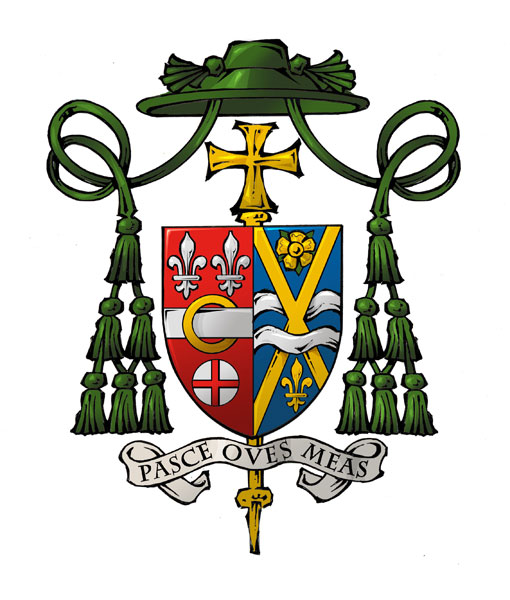 The bishop's coat of arms is composed of a shield, with its symbols,
a motto scroll, and traditional external additaments. The shield,
which is the central feature of any heraldic device, is described, or
blazoned, in archaic terminology developed in the mid-12th century
when heraldry took root. By heraldic tradition, the arms of the bishop
are impaled with the arms of his diocese on the same shield, with the
diocesan arms on the viewer's left (dexter), and his personal arms on
the viewer's right (sinister).
The bishop's coat of arms is composed of a shield, with its symbols,
a motto scroll, and traditional external additaments. The shield,
which is the central feature of any heraldic device, is described, or
blazoned, in archaic terminology developed in the mid-12th century
when heraldry took root. By heraldic tradition, the arms of the bishop
are impaled with the arms of his diocese on the same shield, with the
diocesan arms on the viewer's left (dexter), and his personal arms on
the viewer's right (sinister).
The arms of the Diocese of Allentown were devised shortly after
the diocese was established out of the Archdiocese of Philadelphia by
His Holiness, Pope Saint John XXIII in 1961. The arms of the Diocese
of Allentown are blazoned: Gules a barrulet Argent encircled at fess
point by a ring Or between two fleurs-de-lis Argent in chief and a
cross Gules on a plate in base. The red (Gules) background of the
shield recalls the ardent devotion to the Church of Saint Catharine of
Siena, the patronal saint of the Cathedral of the Diocese of Allentown,
which led to the return of Pope Gregory XI from Avignon to Rome.
The golden ring on the silver bar (a barrulet Argent encircled by a
ring Or) is a representation of the ring, given to Saint Catharine by
34
Our Lord during an apparition, signifying her mystical marriage to
Christ. The two silver stylized lilies (fleurs-de-lis Argent) are taken
from the coat of arms of Pope Saint John XXIII to honor the Pontiff who
established the Diocese of Allentown. On the Pope's original arms,
they signified the Blessed Virgin Mary and Saint Joseph. The silver
roundel bearing the red cross (a cross Gules on a plate) is derived
from the three such roundels on the coat of arms of the Archdiocese
of Philadelphia. This commemorates the Archiepiscopal See which
gave the Counties of Berks, Carbon, Lehigh, Northampton, and
Schuylkill to form the territory of the Diocese of Allentown. These
roundels were, in turn, taken from the coat of arms of the Penn
family, the Proprietors of the Province of Pennsylvania Colony, who,
in 1733, authorized the first legal public Catholic Mass in the British
Empire since the Reformation.
His Excellency's personal arms are blazoned: Azure a saltire Or
interlacing two bars wavy Argent between a rose Or barbed Vert in
chief and a fleur-de-lis Or in base. The blue (Azure) field represents the
all-encompassing mantle of our Blessed Mother. The gold decussate
cross (saltire Or) is the X-shaped cross of Saint Andrew, the Apostle
who first followed Christ, and gives homage to Bishop Schlert's
middle name, Andrew. The two gently undulating white lines (two
bars wavy Argent) reference his native city of Easton in Northampton
County, Pennsylvania at the confluence of the Delaware and Lehigh
Rivers. The gold rose with green leaves (rose Or barbed Vert) is for
the Bishop's devotion to Saint Therese de Lisieux, called "The Little
Flower of Jesus," as well as a reference to his mother's maiden name
of DeRose. A gold stylized lily (fleur-de-lis Or) is carried-over from
the arms of the Diocese of Allentown, where it represents a personal
devotion Bishop Schlert has to the Blessed Mother.
Below the shield, a scroll is inscribed with His Excellency's chosen
episcopal motto Pasce Oves Meas ('Feed My Sheep') taken from the
Gospel of Saint John, chapter 21, verse 17. For Bishop Schlert, these
words serve as a mandate from Christ at the beginning of each day
and an examination of conscience before retiring at the end of each day.
35
Above the shield is placed a low-crowned, wide-brimmed hat,
known as a galero. The ecclesiastical hat has been used by members
of the Church hierarchy since first granted by His Holiness, Pope
Innocent IV at the Ecumenical Council of Lyon in 1245. A bishop
uses a green galero with twelve tassels, called fiocchi. Lastly, behind
the shield of a bishop is placed an episcopal cross, signifying the
bishop's authority and governance in his diocese.
Coat of Arms of the Diocese of Allentown
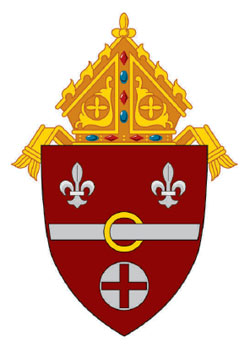
The golden ring on the silver bar symbolizes St. Catharine of Siena,
the titular saint of the Cathedral of the Diocese of Allentown. The ring designates
her mystical marriage to Christ, a ring given to her by our Lord in an apparition.
The red background of the diocesan shield signifies the sufferings of Catharine at
the hands of her parents, and recalls her devotion to the Church leading to the
persuasion of Pope Gregory XI to return from Avignon to Rome. The two silver
fleurs-de-lis are taken from the coat of arms of His Holiness, Pope John XXIII,
to honor the Pontiff who established the Diocese of Allentown. The silver roundel
bearing the red cross is derived from the coat of arms of the Archdiocese of
Philadelphia to commemorate the See which gave the Counties of Berks, Carbon,
Lehigh, Northampton, and Schuylkill to form the entire territory of the Diocese
of Allentown.